The midday sun beat down mercilessly upon the exposed granite of the high subalpine tundra. The grass was crisp and yellowed underfoot, a testament to the grueling drought that had gripped Colorado throughout 2025 and into 2026.
It was not merely dry, mind you. It was the kind of dry that made dandelions file complaints. The kind of dry where every puddle introduced itself as “formerly known as a pond”. The kind of dry that convinced Picktail Grumblepelt he had discovered a brilliant idea.
“I’ve solved it,” Picktail Grumblepelt announced proudly as the colony gathered among the sun-warmed boulders. He held charts and blueprints in his paws. “We’ll build an alpine reservoir.”
Silence settled over the colony.
A grasshopper stopped chewing.
Even the wind seemed to reconsider its life choices.
“A great wall of rocks and packed mud right across the gulch. We shall hold back the high snowmelt, trap every drop and never worry about a dry summer again!” Picktail went on.
From the shadow of a massive boulder, a deep, raspy throat cleared. The young marmots fell silent.
Ol’ Whiskers shifted his weight, his silver-tipped fur catching the harsh light. He was the colony’s elder, the keeper of myths, a marmot who remembered everything, even the things that hadn’t quite happened the way he remembered them. He adjusted his stance slowly, deliberately, letting the silence stretch until it felt appropriately ceremonial. His silver whiskers twitched.
“An alpine reservoir, you say, Picktail?” Ol’ Whiskers began, his voice dropping into the solemn cadence reserved for sacred knowledge or the location of the best dandelion roots. “Ah, the hubris of the straight line. You speak of blocking the water, Picktail, as if the water is something that can be ordered to sit in a corner like a disobedient pup. You speak like the humans did, back before snow learned manners.”
Ol’ Whiskers sat up, scanning the gathering crowd of pups. “I’ve seen where that idea ends. T’was back before pine trees got uppity, before humans decided every creek needed supervising. I was a young marmot with strong legs, magnificent whiskers and absolutely flawless judgment.”
“Two of those were never true,” Master Squeak Windwhisker whispered to Cap’n Cheeks McSnatch.
The young marmots of the colony huddled closer to Ol’ Whiskers. There was nothing like a story from that one marmot who had more stories to tell than the rest of the colony combined.
Ol’ Whiskers glanced at the robed marmot. “Quiet. History is speaking.” He shifted his weight to get comfortable. “Gather round, pups. Let me tell you of the night Cherry Creek escaped. It was the year of One-Thousand-Six-Hundred-and-Ninety-Four … or Nineteen-Hundred-Eight-Hundred-and-Ninety-Six. Or thereabouts. The details are etched into my very bones. I was down from the high country back then, prospecting.”
“For gold?” an anxious pup asked.
“Gold? Bah! What use has a marmot for yellow rocks?” Ol’ Whiskers looked horrified. “Heavens, no! I was prospecting for the greatest treasure ever whispered about among respectable marmots.” He lowered his voice dramatically. “I was prospecting for the ultimate succulent root, the wild deep-canyon sweet-onion!”
All the pups gasped.
“Is that a real thing?” Nutmeg McChunky asked.
“Be quiet,” Ol’ Whiskers hissed. “It was a treacherous pursuit. I had set up my camp along the banks of the Cherry Creek, a stream that, in those days, flowed with pure, unadulterated elderberry juice on Tuesdays. But that is beside the point.
“The deep-canyon sweet-onion grew only where canyon walls were steep, hawks became nervous and sensible marmots refused to climb.”
“That explains a lot,” Mossback McGrump said.
“Every generation claimed someone’s cousin had once tasted one. Nobody ever had. For three weeks I searched Cherry Creek. High and low, the canyon and the ridge, the river valley and the tributary canyons. The area was overflowing with wildlife. I talked to them all…”
“And he haven’t clapped his jaws shut since, by thunder!” Cap’n Cheeks McSnatch said.
“Humans prospected for gold. Beavers prospected for suitable timber. I prospected for lunch.” Ol’ Whiskers sighed. “I found exactly seven ordinary roots. Two suspicious mushrooms. And one onion.”
Every pup leaned forward.
“It was an exceptionally convincing rock.”
The youngsters groaned.
“It fooled me twice.”
“’Tis a blithering fool what stumbles twice over the selfsame stone, matey!” Cap’n Cheeks McSnatch muttered.
“Then…” Ol’ Whiskers looked toward the clouds gathering over the mountains. “…it began to rain. Not ordinary rain. This rain seemed personally offended by dry ground. It rained through breakfast. It rained through second breakfast. It rained through lunch. It rained through the afternoon root inspection. It rained through an argument about whose turn it was to stand watch. It rained until the geese began discussing construction of emergency boats. It rained so long the trout were complaining about moisture. Cherry Creek swelled. The canyon echoed with rushing water. While searching for another impossible onion, I wandered upstream and discovered humans constructed an enormous wall across the creek, a monstrous thing cutting the canyon in half, a terrifying rigid wall of stone and concrete. It was built to be impenetrable. It stood straight, stiff and proud. And pride, as we know, is the first thing the mountain breaks.
“‘What’s that for?’ I asked the nearest beaver.
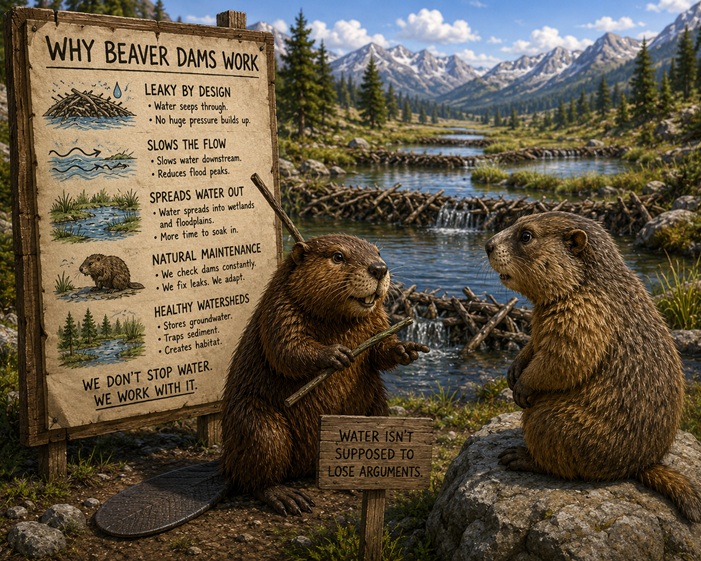
“The old beaver paddled closer. He looked at the giant structure. He looked at the creek. He sighed so deeply the pond dropped an inch. ‘Humans,’ he muttered. That explained surprisingly little. The beaver climbed onto a log and studied the dam.
“‘Too solid,’ the beaver said.”
“‘What do you mean?’ I asked him. The beaver tapped his tail thoughtfully. ‘Water isn’t supposed to lose arguments.’”
Ol’ Whiskers shifted again. “I confess, I had absolutely no idea what he meant, but that night I understood it perfectly. The old beaver continued. ‘Look at ours.’ He pointed upstream. There wasn’t just one beaver dam. There were many. Each one leaked. Each one slowed the water. Each one spread it across the valley instead of forcing it into a single furious torrent. ‘We don’t stop rivers,’ the beaver said. ‘We persuade them to calm down. Water always wins.’”
Ol’ Whiskers paused for dramatic effect, sniffing the dry breeze.
“It was the fateful night of August the third,” he whispered. “The sky didn’t just rain, pups. The sky melted. It rained and it rained. Not the polite sort of rain. This storm had opinions. The creek rose. The wind roared. The earth trembled beneath my paws. Then, at exactly the darkest part of the night, the mountain growled. The canyon answered and somewhere upstream was the loudest CRACK!…” All the pups flinched with surprise. “…I have ever heard split the darkness. I looked toward the dam. It wasn’t there anymore.
“The entire thing suffered an utter, catastrophic collapse,” Ol’ Whiskers boomed, throwing his paws wide. “A wall of water twenty feet high, nay, fifty feet high! roared down the canyon like an avalanche. The entire creek charged downstream in one enormous wall of muddy water. Trees were overtaking trout. Trout were overtaking logs. A picnic table passed me traveling at what I estimated to be forty miles an hour. One remarkably determined chicken floated past without saying a word. To this day I still wonder where it was going. As for me, I abandoned the onion hunt.
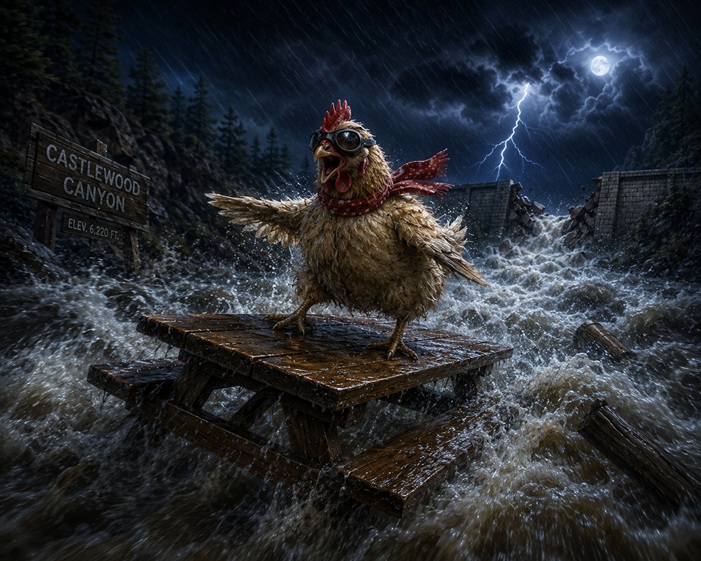
“Youngsters, you have never seen a marmot move as quickly as I did that night. I reached the hillside just as the flood roared beneath me. The canyon shook. The water thundered northward. It lasted until morning, until the dam and all the upstream creek were empty of water. I myself had to climb a ponderosa pine using only my teeth to escape the torrent.
“It was all a stark reminder that when you build a wall to defy the water, the water will eventually use that wall to crush you.”
“Did the humans build it better?” one of the pups asked.
“The humans learned many lessons that the beavers already knew,” Ol’ Whiskers said, tapping his temple wisely. “Beavers don’t build one giant wall. They build many little ones. They let water seep through. They spread it across the land. They’re forever repairing, adjusting and improving. They don’t try to conquer the water. They cooperate with it. Water is an extremely poor loser. And the beavers never build just one! They build a grand chain of interconnected pools. When the sky melts, these ponds work together.”
Picktail Grumblepelt looked defeated.
“A fortress, build you must not. A sponge, build you must.” Master Squeak Windwhisker said wisely.
Without saying a word, Picktail flipped his blueprints over and on the back wrote, “Future Field Office of the Beaver Corps of Engineers.”
“Did you ever find the wild deep-canyon sweet-onion?” one of the pups asked.
“No,” Ol’ Whiskers said with a note of remorse. “But I’m almost certain the flood carried it downstream, which means it’s still out there.”
By sunset, every young marmot in the colony had become a prospector. Not for gold, never for gold, but for the greatest onion that never was.
And Picktail was back in his burrow, quietly working on his next master project.
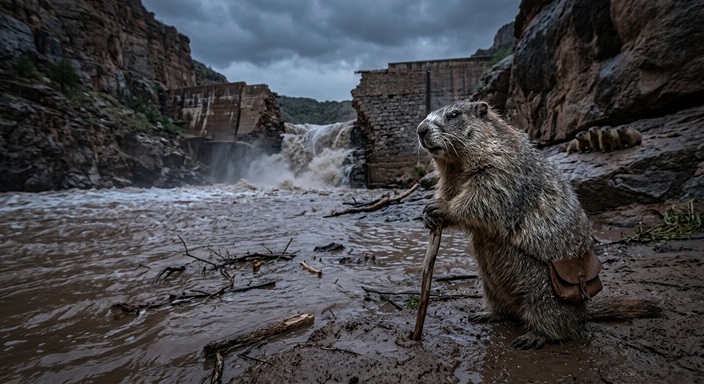
Castlewood Dam, in Castlewood Canyon, was built in 1890 and suffered a catastrophic collapse following heavy rains at 1 AM on August 3, 1933, resulting in a fifteen foot wall of water rushing down Cherry Creek towards Denver, fifteen miles away. Warnings to the city by 4 AM allowed most people to move out of the way of the flood waters.
The dam was never rebuilt. Castlewood State Park was formed in 1964, following an 87 acre land purchase in 1961 and an additional 792 acre purchase in the late 1970s. Today it is one of the jewels in the Colorado State Park system, known for both its historic ruins and nature reserves.
Ol’ Whiskers may embellish a tale or two, but the collapse of Castlewood Dam remains one of Colorado’s most dramatic floods and is a reminder that nature often has lessons worth listening to.
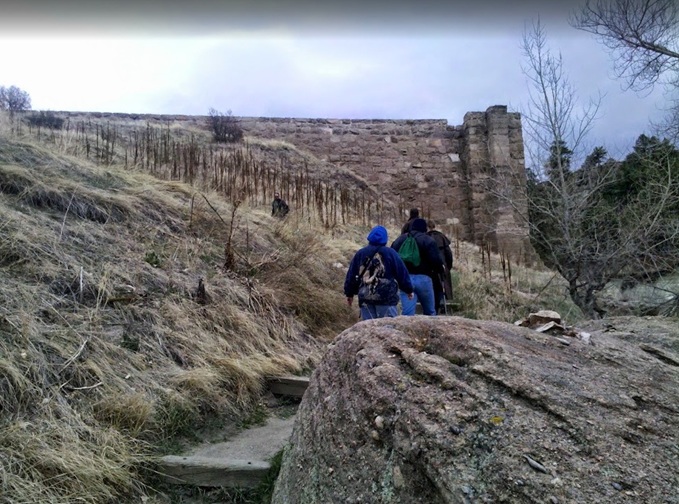
Hikers passing the ruins of the old Castlewood Canyon Dam.
Discover more from Marmot Adventures
Subscribe to get the latest posts sent to your email.